He Loses Half His Jobs to Voicemail — So I’m Building Him an AI Answering Service
Half his jobs. That’s what voicemail costs Patrick Nagel — and an AI answering service is what we’re building to stop the bleeding. Episode 3 is the Discovery: before a single automation gets built, we sit down and map every lead, call, and follow-up in his business to find exactly where the money leaks out.
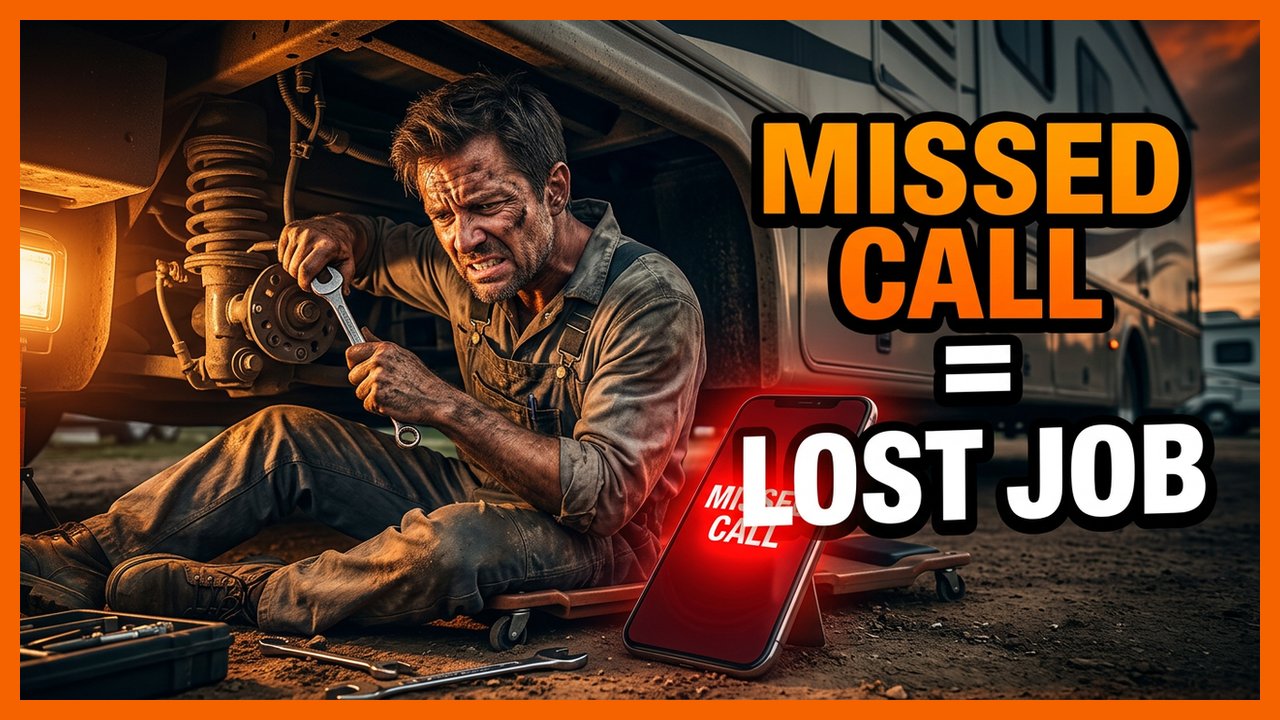
Patrick runs Dixie RV Doctor, a mobile RV repair business in St. George. He’s good at his job. His prices are fair. And he still loses roughly one out of every two jobs — not to a competitor with better tools, but to a missed phone call.
The math that’s quietly killing him
When Patrick started, there were about 6 mobile techs in his market. Today there are 30. That changes everything about how customers behave: when someone’s AC dies in an RV in a Utah summer, they don’t leave a voicemail and wait politely. They hang up and dial the next tech on the list.
So the only tech who gets the job is the one who answers. And Patrick physically can’t — he’s a one-man operation, and one-man operations spend their day under RVs with a torque wrench, not next to a phone.
His lead system: 20+ pinned text messages
Here’s my favorite discovery of the whole episode. Patrick’s CRM is his phone’s text app — 20-plus potential customers, tracked by pinning conversations to the top of the screen.
Laugh if you want, but that’s how most one-man businesses actually run. And it works, right up until it doesn’t: every text that slips below the pins is a job that quietly dies. No follow-up, no reminder, no record. Just gone.
From pipeline welder to RV doctor
Patrick’s story is why this episode matters beyond the tech. He spent 12 years on the road as a pipeline welder, living in an RV the whole time. When a policy change dried up his pipeline work, he pivoted to the thing he already knew inside out — fixing RVs — and walked into a market exploding with demand.
He built a real business the hard way. The business just outgrew the phone in his pocket.
What Discovery actually looks like
This is the part most AI content skips. Before we build anything, we map the whole operation: where leads come from, what happens when a call gets missed, how estimates go out, who follows up, and where jobs fall through the cracks.
By the end of the episode there’s a clear picture of the system we’re building:
- An AI answering service that picks up every call Patrick can’t, captures the job details on the spot, and texts him a summary.
- A real CRM to replace the pinned texts, so every lead has a record and a next step.
- Follow-up automation so no estimate dies in silence.
No inspiration-video hand-waving. A real workflow problem, mapped on camera, with the build coming next — same deal as the job search automation I built my wife in Episode 2.
Why the AI answering service comes first
Because it’s where the money is. Recovering even a fraction of the calls Patrick currently loses pays for the whole system many times over. The CRM keeps leads alive and the follow-up automation closes the loop, but the phone is the front door — and right now the front door is closed half the time.
That’s the standard I’d tell any small business to apply to AI: don’t start with what’s coolest, start with the leak that costs you the most.
The human part
There’s a moment in this episode that has nothing to do with technology. Patrick talks about what it would mean to finally shut his phone off at dinner — to be present with his family without wondering which ringing phone is a $2,000 job about to call the next guy.
That’s what these builds are actually for. The AI answers the phone so Patrick doesn’t have to be two people at once.
What’s next
The Discovery is done and the build starts now: the AI answering service, the CRM, and the follow-up engine, all built in public — including whatever breaks along the way, because something always breaks.
Subscribe and hit the bell so you catch the build episodes as they drop.
And if you run a business with a real workflow problem that’s quietly driving you nuts, become a Build Partner: show up for three episodes, be honest about what’s working and what isn’t, and actually implement what we build. That’s the deal — email eam@x7ai.ai.
Real builds. Real struggle. Real results.